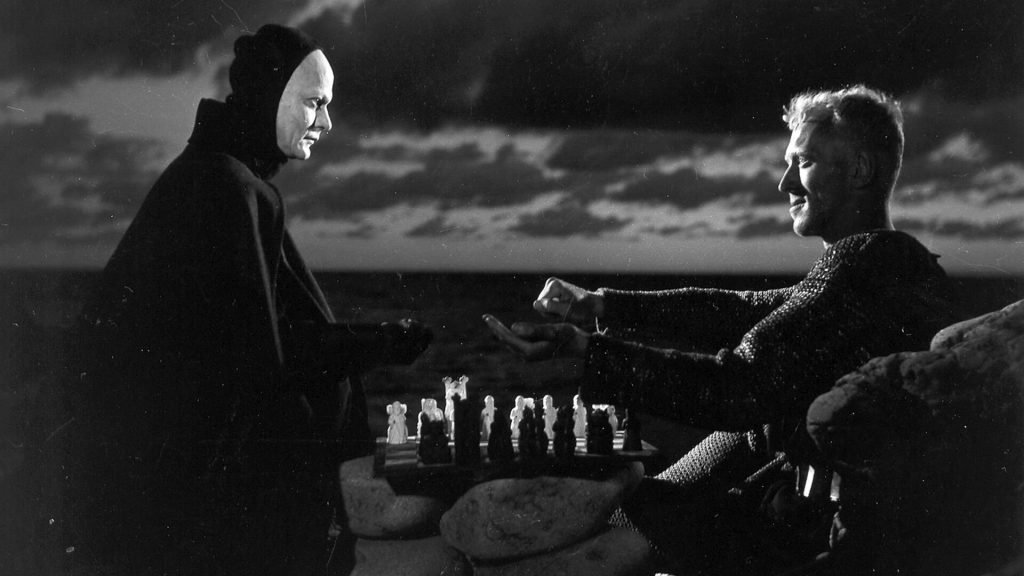
Ingmar Bergman’s films delve into the depths of the human psyche, revealing profound insights into the complexities of existence with haunting precision. While the extensive filmography of Ingmar Bergman offers numerous perspectives for analysis, this essay will focus on two specific book chapters that examine different aspects of his work. The first source illuminates the recurring themes and components in his films by analyzing the film’s style. Subsequently, this essay will address the divergent opinions surrounding Bergman’s market value and the significant agents Bergman has had for the funding of his films in the second source.
In The Journey: The Seventh Seal and Wild Strawberries (2003), Jesse Kalin[1] presents a thematic and stylistic analysis of Bergman’s two films, The Seventh Seal and Wild Strawberries. Kalin begins by noting that both movies are a ‘final journey’ by their protagonists in search of ‘something essential in their life that has been lost’.[2] While Wild Strawberries is a ‘drama of rebirth’ through both ‘reappropriation and replacement’ of that loss, The Seventh Seal‘achieves only the latter’.[3] Despite the ‘final refusal of closure’ in the ending of Wild Strawberries, Borg’s narrative presents a more explicit sense of hope for a ‘new beginning’ through the protagonist’s journey of self-discovery and reconciliation, in contrast to Block’s resigned acceptance of his fate.[4] However, Block’s ‘journey does achieve a retrieval and rebirth of life’ by ‘saving Jof and his family from death by diverting death and sacrificing himself’. Through that gesture of sacrifice, Kalin further adds, ‘Block saves life itself’.[5]
In the first half of the chapter, Kalin delves into the exploration of the philosophical question about God and His presence in The Seventh Seal. Kalin argues that the film presents two main arguments surrounding the topic. The first one is that ‘God is silent and absent’, it argues that God must be ‘palpable’ and ‘someone who answers questions’, but he is only present in the minds of ‘People’ ‘out of their fear’.[6] Block finds himself ‘repelled’ by ‘pure faith’ and ‘desperate’ for ‘absolute knowledge’.[7] On the other hand, the other argument ‘counterposes this dismissal with an account of God as immanent and identical with the spiritual in man’.[8] God, the Devil, and Jesus symbolize human truths, offering mirrors for self-reflection. Their narratives transcend religion to become artistic representations of our deepest needs and understandings.[9] Kalin concludes by examining the Final Judgements of God in the film and how characters like Block, who rely on knowledge rather than faith, become disconnected from God.[10] Unlike Borg, who experiences repentance, Block remains unchanged and resolute in his demands, leading to a life of emptiness, fear, and disgust, ultimately culminating in a ‘pitiless death’.[11]
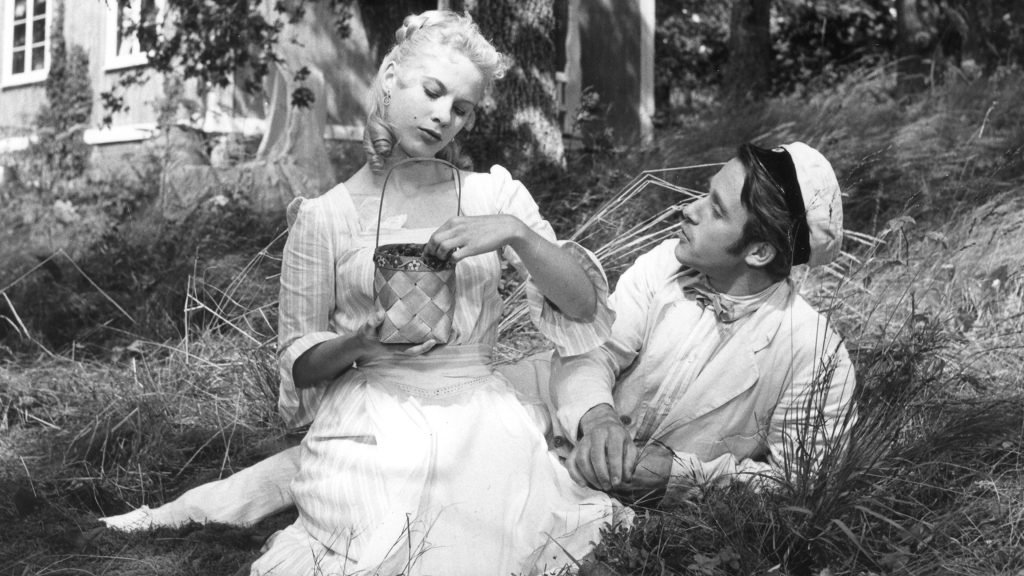
In the latter part of the chapter, Kalin analyzes Bergman’s visual communication in Wild Strawberries, focusing on meticulous mise-en-scène and shot composition. An example discussed is Marianne holding a doll next to an old clock when meeting Isak’s mother. Kalin highlights the clock’s symbolic significance, suggesting Marianne’s pressure to decide on having a baby before it’s too late.[12] This moment resonates beyond Marianne’s internal struggles, connecting to one of the central themes of the film: not just the act of having children, but the acceptance of them as part of our lives, regardless of their origins.[13] This theme is woven into various aspects of the story, such as Isak’s distant attitude and ‘coldness’ towards Evald and the potential fate of Marianne’s child if she continues on their predetermined path.[14] Kalin further admires the mode of composition in the car conversation scenes, highlighting the isolated shots and the inward and outward movement of the characters as reflective and choreographed expressions of the drama ‘at the heart of their relationship’.[15]
Overall, The Journey: The Seventh Seal and Wild Strawberries (2003) serves as a valuable resource for delving deeper into the two films, offering insights into the essence of Bergman’s “metaphysical reduction”.[16] By reflecting on the notion of “the axis of turning” as outlined in the presented ontology, readers are exposed to Bergman’s perspective that we coexist in solitude, yet are interconnected with others.[17] It highlights that our individual ‘portraits’ rely on the inclusion of those who share our journey.[18] Kalin also discusses Bergman’s technical skill, which reinforces narrative themes. Additionally, Kalin explores recurring themes, narrative structures, and objects like the chess game and wild strawberries in both films.
The source also presents elements of interdisciplinarity in its discussions on existential themes and God which intersects with philosophical concepts regarding the subject. Kalin also mentions ‘the walls of the church visited by the knight and his squire are covered with paintings of the dance of death, sinners and penitents, and the plague itself, while the crucial fact that Death plays chess, the information that allows Block to stall for time is known from painting and ballads’, which is a reference to art history and culture studies. [19]
While the source lacks insights into the historical context of the films, it provides a thorough examination of the style in Wild Strawberries. However, its analysis of The Seventh Seal is limited, primarily focusing on the theme of God and His presence in the film, rather than also conducting the comprehensive technical exploration observed in its analysis of Wild Strawberries.
Moving onto Bergman and the Business: Notes on the Director’s ‘Worth in the Market’ (2021), Eric Hedling[20] presents an analysis structured around three case studies. These studies aim to shed light on several overlooked issues while also emphasizing the extensive impact of Bergman’s activities in the film industry. The first examines Bergman’s position in Sweden during the late 1950s, the second explores his relationship with Hollywood agents, and the third investigates his connection with Janus Films, the company that became SF’s US distributor in 1958.[21]
Hedling notes tensions in discussions between Bergman and Dymling, particularly regarding issues like screening copy quality and the studio’s sound department.[22] Bergman’s dissatisfaction with sound led to the dismissal of Svensk Filmindustri’s sound department and the supplier of the sound system during filming.[23] However, there were other occasions when Dymling’s actions, decisions, and opinions had more far-reaching consequences for Bergman’s work. As an example, Hedling illustrates how Dymling persuaded Bergman to shoot Through a Glass Darkly (1961) in black and white instead of color. Dymling advised Bergman to wait for a suitable comedy script before transitioning to color, leading to the decision to film in black and white.[24] Hedling further adds that Bergman’s stylistic choices in his 1960s films, including reduced size, chamber-play aesthetics, and black-and-white cinematography, reflect his awareness of financial constraints and risk management. Despite aiming for high art aspirations in a shrinking market, Bergman prioritized remaining an independent and active filmmaker over increasing production costs.[25]
Bergman’s connection to Hollywood was only through agents and as one of his agents Harvey puts it, ‘agents were an inescapable fact of life in the American entertainment industry’.[26] Bergman’s two agents at the Hollywood before Janus’ Cyrus Harvey were Bernhard L. Wilens from Morris Agency and Katharine Kay Brown of Lew Wasserman’s MCA agency. Hedling points out that ‘one can detect a slight simmering, implicit discord from the starts’ with the former, whereas ‘there are no hints of friction’ with the latter.[27] ‘Indeed, Bergman soon proclaimed his admiration for Brown’s stately and elegant business prose’.[28]
In 1958, Janus and SF forged an agreement, meticulously coordinating the rollout of numerous films while deliberately nurturing the ‘Bergman brand’.[29] Although Janus Films’ contract was with SF, a personal and intimate exchange blossomed between Bergman and Harvey, serving as a channel for Bergman’s suspicions, grievances, and vexations regarding SF and Dymling. He harbored a sense of financial exploitation by SF after being denied complete transparency regarding the revenue SF accrued through Janus.[30] Hedling further mentions Bergman’s frustration after Dymling supplied Janus with an edited version of The Virgin Spring at the request of Janus for its theatrical release in Hollywood. [31]
Hedling concludes by illuminating that although he had some freedom in choosing projects and challenging censorship in Sweden, he still encountered limitations imposed by industrial and financial realities, as well as personal constraints. As a result, Hedling notes, Bergman’s ‘worth in the market’ was always relative, and he continually grappled with these challenges in his filmmaking journey.[32] Hedling observes a perception that during the ‘Bergman craze,’ Bergman appeared detached from market forces, despite facing constraints.[33]
This source’s primary strength lies in its thorough examination of Bergman’s market value from multiple angles, avoiding blind trust in SF and Dymling’s apparent ‘blank cheque offer to Bergman’ or solely accepting Bergman’s assertion of his value as ‘zero’ in his memoir.[34] Hedling critiques Bergman’s perspective by analyzing correspondence between Bergman and his agents, as well as the audience interest in his films over the years. However, this reading falls short in being limited to considering only two years, 1959 to 1961 in exploring Bergman’s ‘worth in the market’.[35]Nevertheless, it does acknowledge certain appraisals, constraints, restrictions, and forms of restriction that Bergman faced in his dealings with industry intermediaries (like producers, agents, censors, and distributors) as he strived to create films with minimal interference and increasingly in alignment with his own vision; or as he described it, in harmony with his ‘longing for pure artistry’.[36]
Both sources utilize relevant quotes and materials to support their arguments. While they both delve into the works of Ingmar Bergman, The Journey: The Seventh Seal and Wild Strawberries offers a contextual exploration of his films, whereas Bergman and the Business: Notes on the Director’s ‘Worth in the Market’ provides insights into the challenges and advantages Bergman faced in marketing his films. Therefore, the two sources are not directly related in terms of content, although each holds its own significance. Additionally, Bergman and the Business: Notes on the Director’s ‘Worth in the Market’ is notably shorter in length compared to The Journey: The Seventh Seal and Wild Strawberries.
Bibliography
- Kalin, Jesse. (2003) ‘The Journey: The Seventh Seal and Wild Strawberries’, In The Films of Ingmar Bergman. Cambridge: Cambridge University Press, 57-85.
- Hedling, Eric “Ingmar Bergman An Enduring Legacy”. Lund: Lund University Press (2021): 42-55.
Accessed March 4, 2024, University of Kent Templeman Library.
[1] Jesse Kalin, The Films of Ingmar Bergman (Cambridge University Press, 2003), pp. 57-85.
[2] Kalin, p. 57.
[3] Kalin, p. 57.
[4] Kalin, p. 63,82.
[5] Kalin, p. 67
[6] Kalin, p. 59
[7] Kalin, p. 59
[8] Kalin, p. 61.
[9] Kalin, p. 61.
[10] Kalin, p. 63.
[11] Kalin, p. 63.
[12] Kalin, p. 69.
[13] Kalin, p. 71.
[14] Kalin, p. 71.
[15] Kalin, p. 73.
[16] Kalin, p. 76.
[17] Kalin, p. 76.
[18] Kalin, p. 81.
[19] Kalin, p. 61,62.
[20] Olof Hedling, Ingmar Bergman An enduring legacy (Lund University Press, 2021), pp. 42-55.
[21] Hedling, p. 44.
[22] Hedling, p. 45.
[23] Hedling, p. 46.
[24] Hedling, p. 47.
[25] Hedling, p. 48.
[26] Hedling, p. 50.
[27] Hedling, p. 49,51.
[28] Hedling, p. 51.
[29] Hedling, p. 52.
[30] Hedling, p. 52.
[31] Hedling, p. 53.
[32] Hedling, p. 55.
[33] Hedling, p. 54.
[34] Hedling, p. 42,43.
[35] Hedling, p. 43.
[36] Hedling, p. 43.