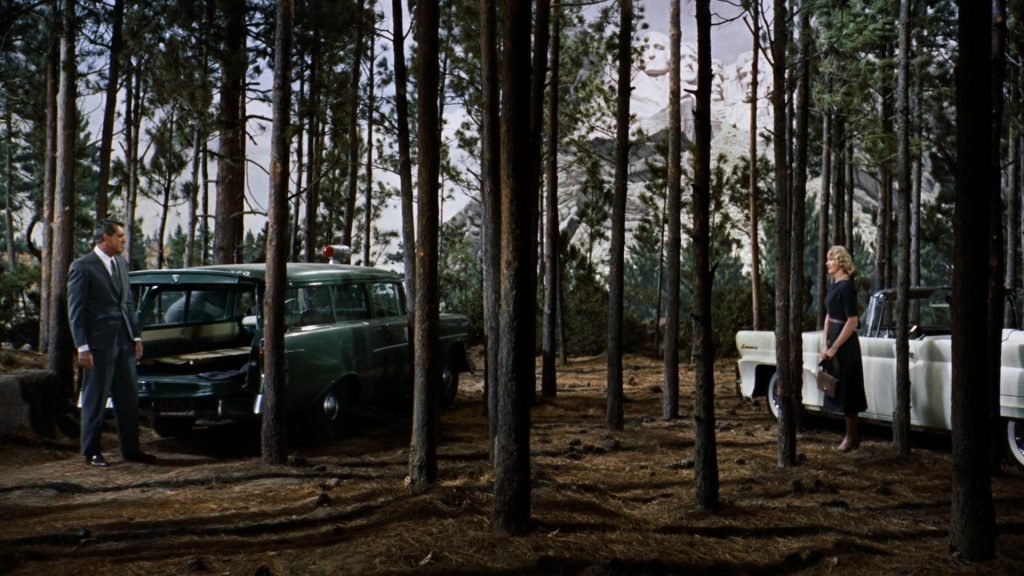
North by Northwest (1959) is an adventure film directed by Alfred Hitchcock. The film is a rollicking journey, laced with excitement that revolves around the theme of ‘Mistaken Identity’. Script by Ernest Lehman. DP by Robert Burks. Edited by George Tomasini. Music by Bernard Herrmann. Starring Cary Grand, Eva Marie Saint, James Mason, Leo G. Carroll, Jessie Royce Landis. Alfred Hitchcock, the esteemed filmmaker is often referred to as ‘The master of Suspense’. He is indeed known for his ability to keep the audience engaged and intrigued throughout his film. Hitchcock manages to maintain the flow of the picture by keeping the plot tied with a chain of cause and effect. The three pivotal emotions that maintain the narrative flow are suspense, surprise, and curiosity.
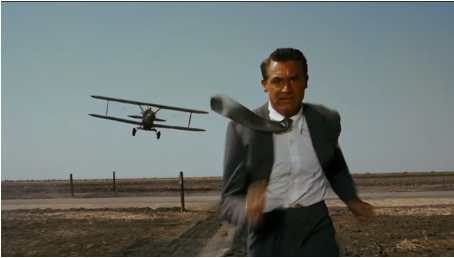
In North by Northwest, Hitchcock juggles with restricted and unrestricted narration to conjure up effects such as surprise, suspense, and curiosity. It is put into action by limiting the viewer to only the information that the character is aware of, resulting in surprising the audience. Whereas suspense is constructed by letting the viewer with information that the character is uninformed of. Elements that evoke curiosity are incorporated to maintain the engagement of the audience. Hitchcock employs various techniques to implement these effects. The most prominent ones are POV narration, crosscutting, shot/reverse shots, shot length and sound. Hitchcock also draws on resources of style like motifs to keep the audience engaged. This essay will delve into Hitchcock’s methods for achieving these effects by closely examining the crop duster sequence in North by Northwest. It is the scene where Roger Thornhill ventures into the middle of a desert to meet George Kaplan but ends up in a life-threatening situation as he nearly gets killed by a crop duster. It is Hitchcock’s one of the many iconic scenes he crafted in his career. The scene’s duration spans approximately ten minutes and features minimal dialogue and music. That said, to attain an in-depth critical analysis of the scene, we can divide the scene into three sections.
In the first section, the film’s protagonist Roger Thornhill is misled into a desert by Eve Kendall, where the former is unaware that he is being misled. However, the audience is aware that Kaplan is a non-existential character set by the USIA, while Eve is working with Van damm. At the beginning of the film, it was the curiosity to find Kaplan that motivated the viewers. However, following the board meeting of USIA, the curiosity shifts to whether Roger will learn the truth regarding Kaplan. Subsequently, the curiosity develops into suspense when the protagonist’s life is endangered due to his lack of knowledge about the situation. According to Hitchcock, Information and suspense goes hand in hand. He believed that by supplying the audience with knowledge the protagonist is unknown of, suspense is constructed because the audience will anticipate whether the protagonist will find the truth or not. (Bordwell, 2013). And by stretching the sequence, the suspense level continuously increases.
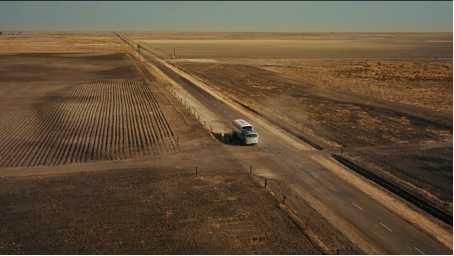
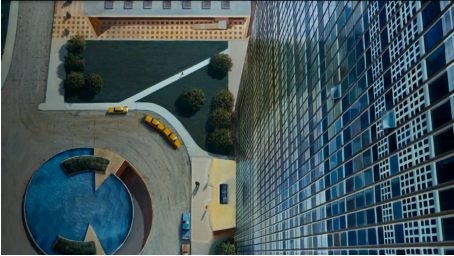
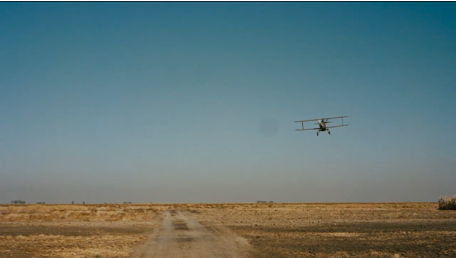
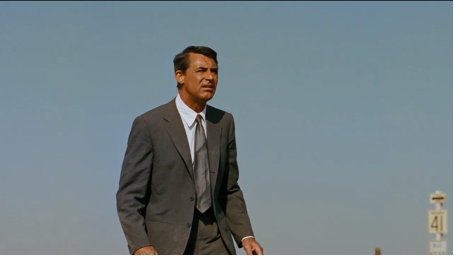
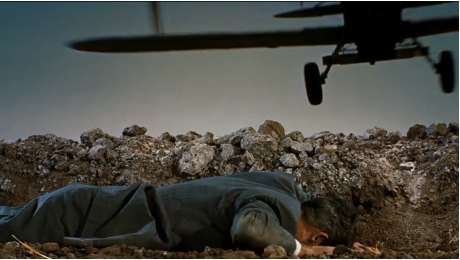
Let us delve further into how Hitchcock exploits time and camera effectively in increasing the suspense of the scene without failing to surprise the audience. Upon being presented with visuals of Eve telephoning Leonard, the surprise element is embedded in the deliberate decision to withhold information regarding the source of the impending threat. Hitchcock accomplishes it by simply muting their conversation. The suspense-building factor lies in acknowledging the audience of the impending danger before Roger, who remains oblivious to the threat that is to come. Suspense is evolved from curiosity by reminding the audience of the looming danger from time to time. And the visual of the conversation reinforces that Roger is being lured into a trap. By acknowledging that Roger’s life is at risk, the foundation is laid in making the next 15 minutes suspenseful. The scene opens with a crane shot of the desert in which Roger exits the bus (Figure 01). This shot also establishes the vastness of the desert to signal the limited help that could be received in such a setting. Hitchcock makes use of dramatic high angle shots when the protagonist is in crisis or something terrible happens. Figure 01 and Figure 02 are examples of visual motifs.
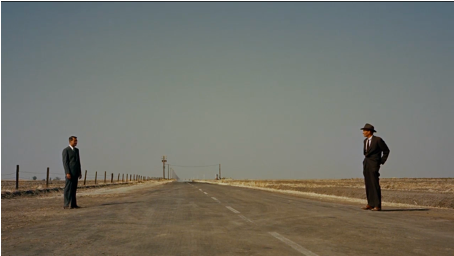
Once Roger steps out of the bus, he starts scanning the barren land for Kaplan, while the audience focus their attention on identifying the killer. Hitchcock puts the audience in the position of Roger mainly by employing optical POV narration to achieve perceptual subjectivity. POV shots and sounds are used to put the spectator in the shoes of Roger, to make the viewer empathize for Roger and have the same or even more curiosity than Roger to find out who it is. The first shot (Figure 01) also signals the limited support that could be received in such a location, intensifying the tension as vehicles pass along the highway. They are anxious whether it is the killer while Roger speculates whether it might be Kaplan. Hitchcock keeps the viewer in the edge when three vehicles pass by Roger. Volume of the vehicles passing contributes a lot in heightening the suspense of that scene. As the car nears Roger, the loudness of the car keeps increasing until it reaches Roger and releases the tension as the car leaves by lowering the volume. Changes in loudness is combined with camera movement and cutting to reinforce our sense of getting nearer or further from the threat. This sequence is an example of how Hitchcock exploits sounds from the film’s diegesis in enhancing the suspense level. And repeating it three times pushes the suspense to the brink. Hitchcock once again leads the audience astray by presenting a man on the opposite side of the road only to reveal two minutes later that he is waiting for the bus. The point is to confuse the audience who wants to figure out where the threat is coming from but is completely clueless. And Hitchcock misleads the audience to thinking that the man is the threat awaiting Roger by juxtaposing two points in space. It establishes a connection between the characters (Figure 03), leading to the deception of the viewer’s perception, diverting their attention in the wrong direction.
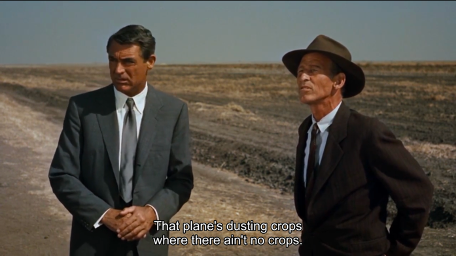
It is the helpless state of the spectator that Hitchcock takes advantage of when he stretches the scene. Hitchcock succeeds in heightening the viewer’s emotional state to the verge by delaying the outcome of a scene. In this scene, he implements it by delaying the answer to what the trap is in the desert. Hitchcock delays the outcome of the scene, akin to the gradual stretching of a rubber band. As a result, the audience keeps anticipating when it will snap. Finally, when it does, it elicits a greater effect on the audience. All these scenes of misleading and POV play a major role in intensifying the suspense. Although Hitchcock imparts information to create suspense, he also deliberately withholds certain information to captivate the viewer’s attention and evoke surprise. By employing POV narration, the filmmaker does not limit the viewer to what Roger knows but to what Roger sees. Hitchcock could have let the audience know where the killer is by crosscutting to the killer’s POV from the plane. However, he decides to let the audience know only when Roger does. This decision is responsible for surprising the audience without compromising the suspense of the scene.