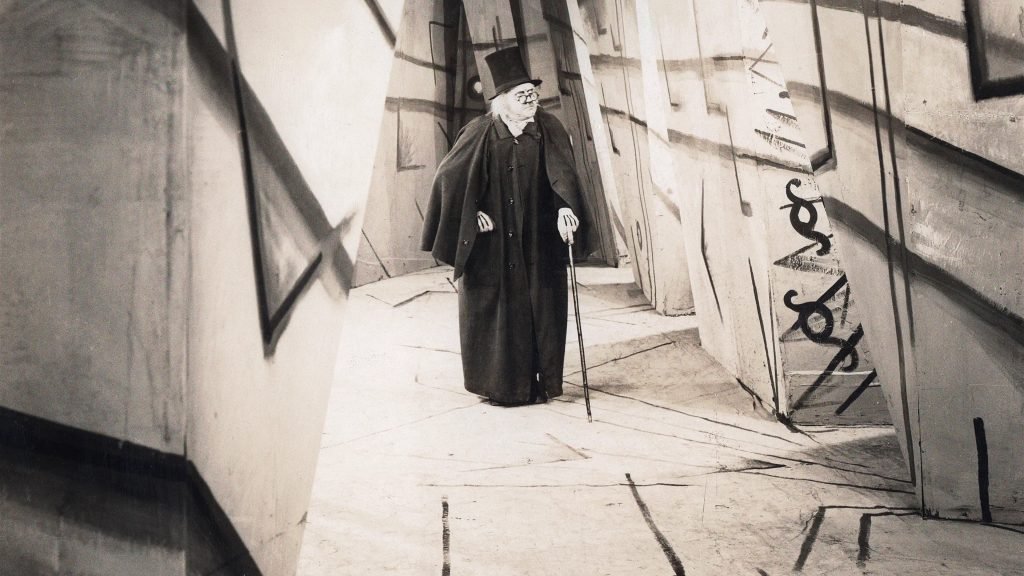
I have opted to delve into German Expressionism through three different sources. My first source is an article discussing the political and ethical ideas of German Expressionists in ‘The German Quarterly’. My second source is a book chapter on The Cabinet of Dr. Caligari (Robert Wiene, 1920) in German Expressionist Cinema: The World of Light and Shadow, examining some of the factors that influenced the style of the film. My final source is also a book chapter from The Expressionists, digging out the origins of the term ‘Expressionism’ and endeavors to provide a definition for it.
The first source discusses how expressionist playwrights and writers viewed their literary works as instruments for political activism and social transformation. Gruber argues that expressionists saw themselves as militant agitators responsible for guiding societal reconstruction, challenging traditional norms, and emphasizing expressionism’s departure from conventional psychology. They advocated for abolishing war to achieve peace, recognizing the importance of fostering universal brotherhood among humankind for lasting peace. Gruber goes on to point out that they were united by their commitment to pacifism, even though they approached its implementation in varied ways. This group embraced principles such as liberty, equality, and fraternal bonds among humanity. Yet, despite their endeavors for peace, they seemed unable to reconcile the inherent contradictions within pacifism. They staunchly rejected the possible ubiquity of human aggressiveness and clung to the belief that ‘true’ pacifism could eradicate aggressiveness. The expressionists aimed to shape the future by placing great faith in individual power, rejecting the psychological view of man as it presented the individual as inherently frail rather than omnipotent and idyllic. Despite acknowledging the impracticality of their utopian ideals, they believed it was better to strive for a utopia than to follow a hopeless path devoid of visionary aspirations. Gruber suggests that “Perhaps the Expressionists chose the transforming power of the individual over the social and political action of the masses because they could not overcome their class origins and ties, or their choice may have been determined by their overabundant ego, which projected the individual writer the role of leader and savior.” (Gruber, 1967). Gruber also mentions their minimal support for the Socialist Party (SPD) due to its endorsement of the war, despite their sympathies for socialism. As an alternative to democracy, Kurt Hiller, a prominent figure among the expressionists, proposed “Logokratie” (Gruber, 1967), or governance by an intellectual elite. However, their impractical and futile proposals garnered ridicule and indifference, leading to their isolation from mainstream political life. Ultimately, the expressionists succumbed to abdication and resignation, retreating into a realm of triviality and banality that marked an artistic and intellectual dead end. Gruber concludes the article by emphasizing the impracticality and disillusionment surrounding the expressionists’ utopian ideals regarding humanity’s capacity for change and the transformative potential of socialism.
Although providing an exact definition of Expressionism’s origins in film presents difficulties, Roberts begins the chapter by highlighting that Student of Prague (Paul Wegner, 1913) already demonstrates many of the characteristics later observed in German expressionist films, particularly following Dr. Caligari. However, the second source delves into Dr. Caligari and its stylistic influences. The compositional element predominantly accounts for the camera’s minimal movement, the stilted behavior of actors, and the use of artificial lighting to create painted effects, evoking impressions of light and shadow. Roberts emphasizes the vitality of a set reflecting an unstable mind in a film depicting the descent into madness and defiance against authority. He goes on to discuss how the success due to the innovative visual style of the film led to disputes over credit among those involved. Examining claims about the film’s stylistic origin is insightful, but Wiene does not clarify who initiated Expressionism in cinema. Although various accounts contradict themselves, set designers recalled having a conversation where they overcame Wiene’s objections to expressionist urban designs during preproduction discussions. Wiene’s framing story was criticized by the scriptwriters for emasculating its effectiveness in producing an anti-authoritarian film. Years later, Fritz Lang revealed that he declined to direct the film and claimed the framing approach as his proposition. Roberts lauds Wiene’s deliberate excision in script elements that enhanced the film’s quality by ensuring that the revised narrative structure reflected the concept of circulation, symbolizing societal upheaval. Roberts builds on this by suggesting that motifs of cycle and revolution in the film, specifically the fair scene offer a sinister interpretation, echoing Germany’s turbulent history. Furthermore, the film effectively conveys its central message of futility and impossibility by initially presenting an innocuous bench conversation, which is later revealed to take place within a lunatic asylum. Initially driven by financial necessity or an effort to legitimize post-war cinema, coupled with innovative mise-en-scene, the film resulted in uniquely stylized set design, painted chiaroscuro effects, and exaggerated acting methods. Roberts concludes without holding anyone solely responsible for the expressionist style but highlights that Wiene and his team established a template for filming themes and motifs preoccupying Weimar cinema.
In the final source, Dube initiates by suggesting that the difficulty in achieving ‘pure’ art for Germans, due to the influence of philosophical concepts like idealism and romanticism, led to the emergence of ‘Expressionism’. Throughout the 1890s, several ‘Secessions’ emerged with a goal to promote familiarity with French Impressionist art and foster international artistic exchanges. At the turn of the century, the works of French Impressionists gained recognition in Germany through exhibitions in Berlin, Dresden, and Munich. The lateness of its arrival simultaneously introduced Post-Impressionism to Germany, which exerted a stronger influence on the artwork of younger German artists. Dube highlights that the term ‘Expressionism’ has multiple suggested origins, mainly due to the journalistic tendency to juxtapose it with ‘Impressionism’. Some attribute its emergence to painter Julien-Auguste Herve’s nature studies labeled as ‘Expressionnisme’, others to critic Vauxcelles’ application of the term to Matisse’s works, and still others to a conversation during a session of the Berlin Secession, where a painting was distinguished from ‘Impressionism’ and termed ‘Expressionism’. The loose application of the term in those years only served to obscure its meaning further, and the artists themselves disavowed any allegiance to it. They believed that while art constantly evolves into new forms, its essence remains unchanged. Thus, they actively avoided using the term ‘Expressionism’. The first academic monograph on Expressionism emerged in 1914, mistakenly aligning it as the German equivalent of French Cubism and Italian Futurism. Fetcher also attempted to provide a clear definition by asserting it as the German counter movement against Impressionism, referring specifically to the German avant-garde. However, Dube contends that although Fetcher managed to establish certain boundaries, the terminology within those limits remained unclear.
Bibliography
Article
Gruber, H. (1967) ‘The Political-Ethical Mission of German Expressionism’, The German Quarterly, 40(2), pp. 186-203.
Books
Roberts, I. (2008) ‘Authority Overthrown OR Lunatics in the Asylum: Robert Wiene’s Das Cabinet Des Dr Caligari’, in I. Roberts ‘German Expressionist Cinema: The World of Light and Shadow’ London: Wallflower, pp. 23-34.
Dube, W.D (1972) Origins in W.D. Roberts ‘The Expressionists’ (translated from German by Mary Whittall), London: Thames and Hudson, pp. 7-22.